


By Bryan Kaus
“The buck stops here” meant accountability in Harry Truman's White House.
In today's boardrooms, it should mean understanding where your customers' bucks actually stop.
McDonald's has always been America's economic bellwether - resilient through recessions and booms alike, with customers instinctively shifting to its value menu when times get tough. For decades, it offered something for all economic conditions.
That formula just broke.
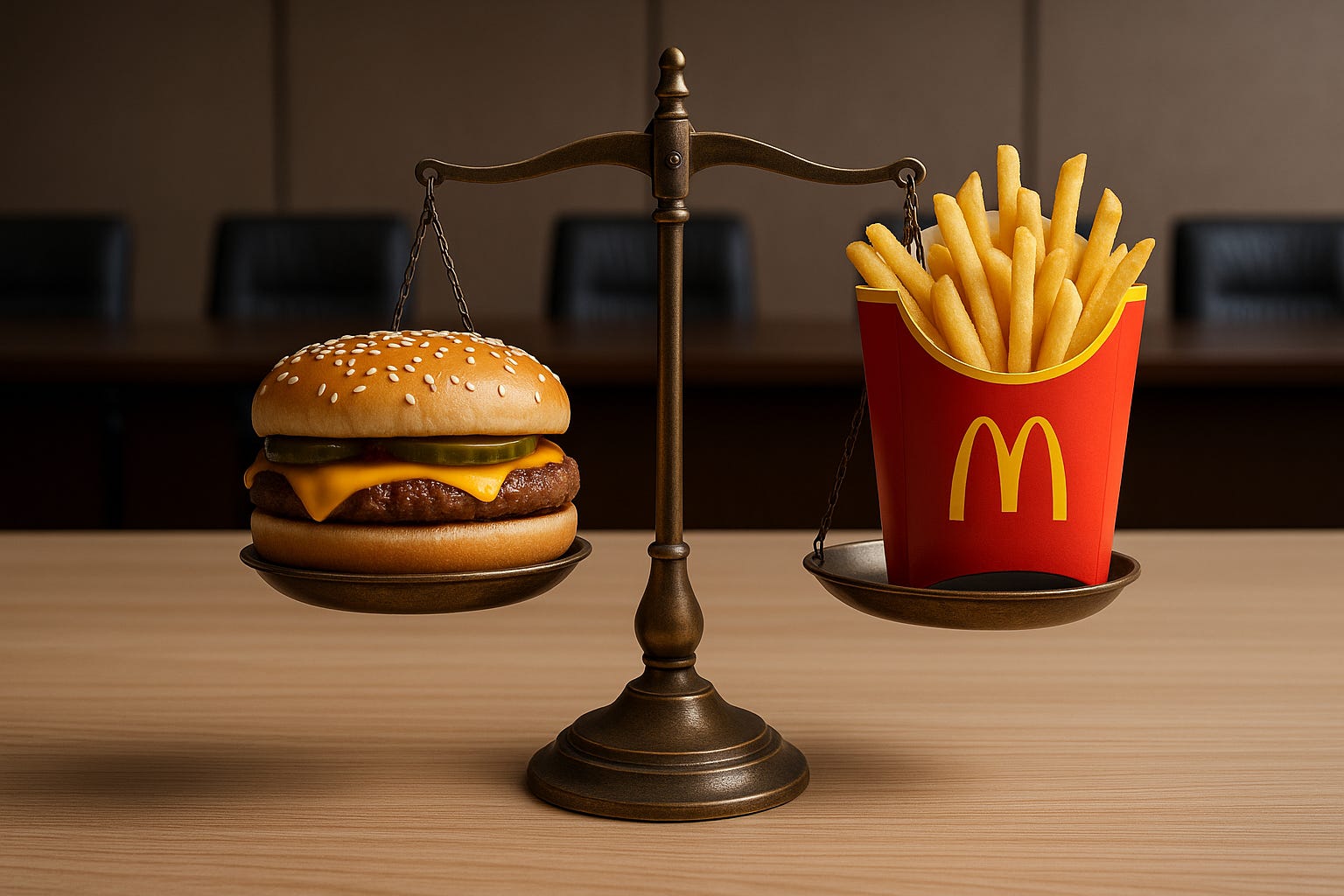
Last week's Wall Street Journal piece laid bare the stunning reality: the golden arches now charge up to $12 for a McDouble "value" meal while their consumer-value score has cratered to its lowest point in a decade. First-quarter U.S. same-store sales dropped 3.6% the sharpest traffic decline since 2020. Customers aren't asking "Where's the beef?" anymore. They're asking, "Where's the value?"
This isn't just a fast-food stumble. It's a strategic warning shot for every executive fighting margin compression while customers grow choosier and cash-strappier by the quarter.
When Value Becomes a Four-Letter Word
McDonald's drift from Ray Kroc's sacred "Quality, Service, Cleanliness & Value" creed happened gradually, then suddenly. Digital upsells nudged average checks skyward just as inflation hammered their core demographic—households earning under $75,000. The $5 Meal Deal they're now desperately promoting tells the whole story: corporate needs foot traffic, franchisees need margins, and customers need respect for their wallets.
The tension exposes a fundamental business law: customers will not subsidize your cost structure indefinitely.
I've witnessed this dynamic firsthand. At Phillips 66, we explored premium pricing for renewable diesel in California, betting on environmental consciousness. We learned quickly that while people loved the concept of cleaner fuel, purchasing decisions came down to pure economics. Good intentions don't pay at the pump - a lesson playing out brutally in today's oversupplied renewable diesel market.
This gap between aspiration and affordability haunts every industry. Fast-food just happens to be the most visible laboratory for value perception, where a $0.50 price increase can trigger customer revolt and a quarterly earnings miss.
The Casualties of Value Blindness
Consider the wreckage when companies lose sight of customer reality:
Red Lobster made their "Endless Shrimp" promotion permanent against management warnings. It blew an $11 million hole in one quarter and accelerated their Chapter 11 filing. Value that bankrupts the provider isn't value, rather it's brand suicide. Value is about mutually beneficial exchange.
Target Canada tried exporting "Tar-zhay" chic north but delivered empty shelves and higher-than-U.S. prices. Result: CDN$2.1 billion in losses, 133 store closures, and 17,000 jobs eliminated - AND all that within two years. Launching without supply-chain integrity is value betrayal at scale.
Peloton mistook pandemic-driven demand for permanent market shift. Their $50 billion peak valuation collapsed to $1.2 billion as reality struck: overbuilt inventory, subscription declines, workforce cuts, and a CEO exit. Assuming temporary shocks are permanent is the fastest way to strand capital.
The pattern is consistent: treat customers as ballast for yesterday's margin model, and the market will grade that paper harshly next quarter.
The Shrinkflation Trap
Here's what most miss: shrinkflation might save margin in Q2, but it bankrupts trust in Q4. Customers notice when candy bars shrink while prices hold steady. They notice when streaming services quietly remove features. They notice subscription renewals that cost more for less.
They notice, they remember, and they leave (especially in discretionary categories).
Anatomy of a Value Recovery
The companies that survive value disruption share four characteristics, visible in these turnaround stories:
Netflix lost 800,000 subscribers during their 2011 Qwikster pricing disaster but learned to meet cash-strapped viewers where they live. Their $6.99 ad-tier now captures 23 million users which equates to 30% of new sign-ups. While some feared it would dilute the brand, it proved that pricing flexibility can unlock growth without sacrificing long-term positioning.
Domino's was synonymous with cheap, terrible pizza by 2008. Their response? The "Pizza Turnaround" campaign that publicly owned their failures while unveiling better recipes and digital ordering. Same-store sales flipped to +14% in 2010; their stock has risen 40× since. Owning failure publicly can reset trust -if you actually fix the root cause.
Microsoft watched PC sales stall and mobile opportunities evaporate. Satya Nadella's pivot to cloud services generated $36.8 billion in Q4 2024 revenue, up 21%. When core demand shifts, re-anchor on your customer's new workflow.
Nike ended their six-year Amazon boycott, surrendering channel snobbery to omnichannel reality. Be wherever your customers want to buy, not where you prefer to sell.
The winners practiced radical listening that led to hard fixes, not cosmetic changes. They innovated around price and financing to match customers' actual cash positions. They showed channel humility - adding ad-tiers or offering payment deferrals isn't retreat; it's revenue insurance. Most critically, they invested against lifetime value, not quarterly performance.
But here's the sobering reality: even successful turnarounds require constant vigilance. Markets evolve, customer needs shift, and yesterday's value proposition becomes tomorrow's vulnerability. The job of re-anchoring value is never finished - it's a continuous process that must be embedded in every strategic plan and revisited on a regular basis - especially when the winds of uncertainty begin to blow.
Beyond Burgers: Universal Value Physics
This "meet-them-where-they-are" imperative transcends industries. Here are just a few examples of this:
Caterpillar offers skip-payment and seasonal-defer financing, showing empathy for customer cash flow while protecting lifetime parts and service revenue streams.
Burger King is spending $400 million on their "Reclaim the Flame" program, remodeling stores while reviving $5 bundles. Despite $400 million in investment and heavy promotion, early results show just 0.1% U.S. comp growth - proof of how fragile traffic becomes when value trust has eroded.
Microsoft staggered Copilot pricing so SMBs could adopt AI without enterprise bundles, lowering adoption friction while creating natural upsell paths.
The strategic lens is consistent across Porter's five forces, Mintzberg's emergent strategy, and Buffett's moat-building: buyer power spikes when substitutes become attractive. The point-of-sale terminal becomes your best early-warning radar. Long-cycle trust trumps quarterly gross-margin maximization. I’ll say that again: Long-cycle trust trumps quarterly gross-margin maximization.
The Executive Playbook: Eight Moves to Re-Anchor Value
Redefine the job-to-be-done quarterly. McDonald's forgot that "cheap, filling calories" was their core promise, not premium sandwiches.
Engineer price-pack architecture with surgical precision. Open-ended promotions invite abuse and are difficult to forecast/mitigate risk exposure - Red Lobster's cautionary tale.
Practice channel agnosticism. Be in-app, on Amazon, through distributors - wherever orders originate, not where margins look prettiest. In it to win it.
Finance your customer's cash constraints. Tailored payment terms convert hesitation into loyalty. Caterpillar's playbook proves this works in B2B.
Instrument sentiment at transaction points. Simple "why didn't you buy?" surveys in POS systems and apps feed real-time value dashboards.
Reward retention over acquisition. It costs 5–25× more to win new customers than retain existing ones - yet most incentive structures reward conquest.
Preserve capacity for strategic give-backs. Leave basis points on the table today to fund tomorrow's goodwill gestures. Keep the long view.
Maintain narrative consistency. Investor presentations, frontline scripts, and social media must echo identical value promises. And be authentic.
The Operations Review That Matters
Skip the usual suspects. Ask these questions instead:
Which customer segment's economic reality shifted this quarter? Detect silent churn before it shows up in retention metrics.
If we cut prices 10% tomorrow, where would we fund it? Stress-test margin resilience before panic promotions become necessary.
What were the top three documented reasons customers churned last month? Transform anecdotes into actionable KPIs.
Do our incentive structures reward lifetime value or transaction volume? Align human behavior with long-term economics.
These diagnostics turn early warning signals into strategic advantage.
The Enduring Truth About Value
Across pizza chains and streaming giants, cloud titans and fitness fads, retail successes and spectacular failures, the verdict remains constant: value is a living contract that demands continuous renegotiation.
Price points, channel access, payment terms, even brand tone—everything signals whether you still see your customer as a person worth serving or a wallet worth emptying. When you refresh these elements in sync with customer reality, you earn compounding trust. When you don't, your P&L turns feral, and no amount of quarterly guidance gymnastics will save you.
To be clear: value isn't synonymous with discounts. It's about durable trust built through consistent delivery on evolving customer needs.
My philosophy: strategy must earn the next sale before celebrating the last one. That's how you build brands and balance sheets that outlive market cycles.
McDonald's is relearning this lesson publicly, with $12 value meals serving as expensive tuition in customer reality. The question for every executive reading this: what's your equivalent wake-up call, and will you recognize it before or after your customers vote with their feet?
Value isn't a marketing slogan - it cannot be. It's the continuously renegotiated contract that determines whether customers return tomorrow - still smiling. Leave a few dollars on the table today to ensure they do. That compound return, not this quarter's EPS beat, is what your board will thank you for in five years.
This is of critical note, especially in a quarter that looks pretty strong but notes about tariff impacts to value chains echo across earnings calls. Managing those pricing pressures effectively through the value system is critical to mitigating risk in the quarters and years ahead. Short-term thinkers will undermine maximum value. Play the long game.
The buck stops with understanding where your customers' bucks go.