



Bryan J. Kaus
Renewable fuels are having a substantially better year.
After a difficult stretch for renewable diesel economics, margins have recovered sharply. German demand for HVO is increasing. European sustainable aviation fuel requirements are becoming more tangible than the voluntary corporate commitments that carried much of the early discussion around SAF. In the United States, renewable diesel production is expected to reach another record, while the regulatory credits that support the economics of producing it have strengthened materially.
It would be fairly easy to look at all of this and conclude that the renewable-fuels thesis has finally reasserted itself.
There is some truth in that. The demand being created by regulation in Germany is real. Renewable diesel has become a meaningful part of the North American distillate pool. Years of investment in feedstock processing, refining capacity, logistics, carbon markets and commercial infrastructure have produced capabilities that did not exist at anything like this scale a decade ago.
But I think the more interesting question is not whether renewable fuels are working again. It is what, exactly, is doing the work.
Several things are moving together right now, and they do not all tell us the same thing about the durability of the underlying business. Regulation is creating incremental demand. Conventional distillate supply is unusually tight. Russian refined-product availability has been disrupted, Middle Eastern product flows remain constrained, and American refiners have responded by running exceptionally hard while U.S. product exports have increased. At the same time, RIN values, tax policy and feedstock eligibility are changing the economics both upstream and downstream of the renewable refinery itself.
There is real money being made in that environment. The harder work for management is separating the portion that reflects a stronger underlying business from the portion being supplied by an unusually favorable market, understanding where else in the value chain some of that value is being captured, and deciding what to do with the cash while the opportunity is there.
Germany provides a useful place to start because almost the entire problem can be seen in one market.
When the mandate meets the river
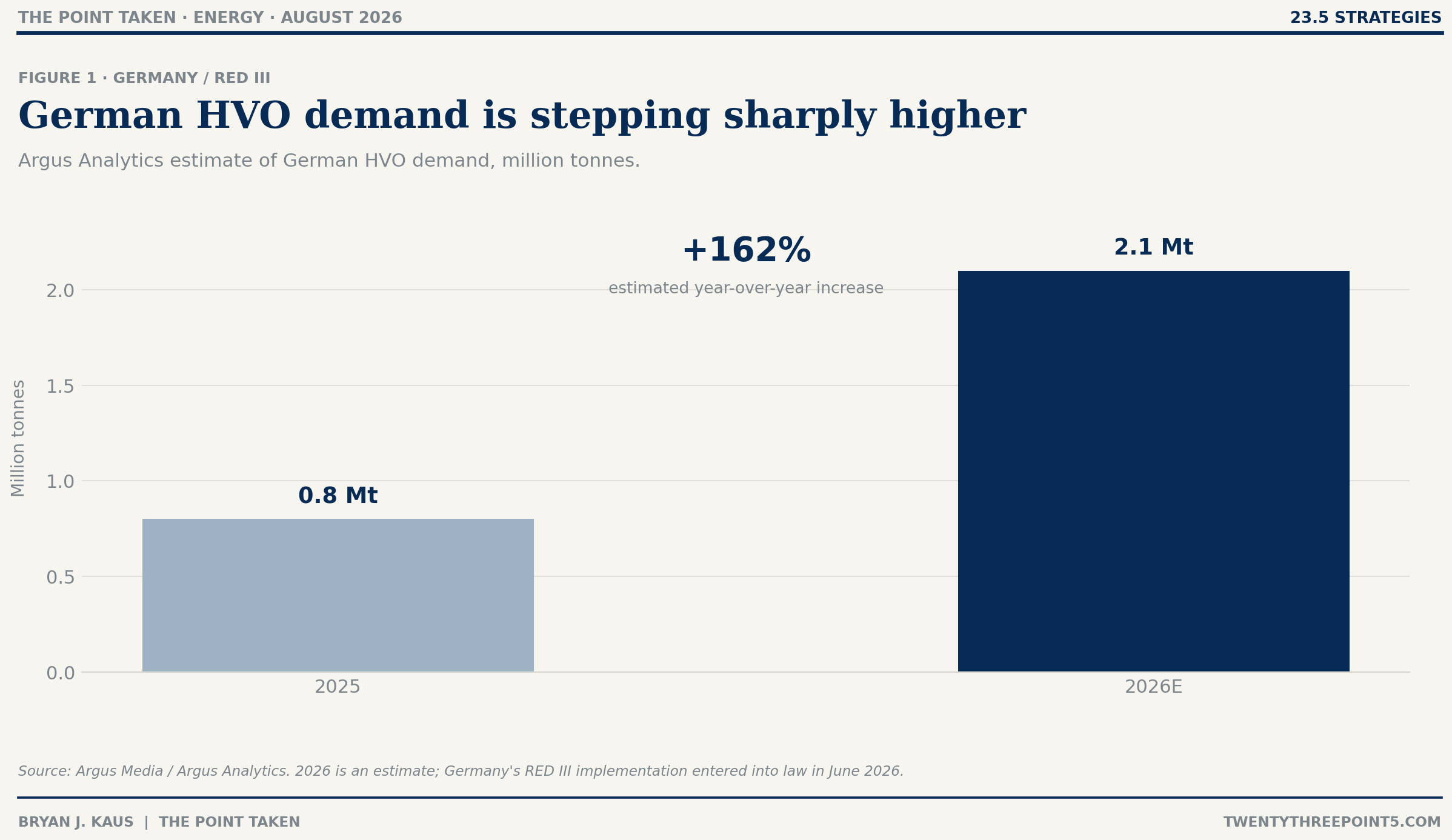
Argus Analytics estimates German HVO demand at approximately 2.1 million metric tons in 2026, compared with roughly 800,000 metric tons in 2025. Germany’s implementation of RED III entered into law in June and eliminated double counting for certain advanced feedstocks, increasing the physical volume of renewable fuel required to satisfy the country’s greenhouse-gas reduction obligation.
That increase alone should give us some pause before accepting the increasingly broad assertion that Europe is simply walking away from decarbonization. European governments are clearly reconsidering parts of the policy architecture, and in a number of cases they have good economic and industrial reasons for doing so. Some of the assumptions embedded in the first iteration of policy have collided with cost, competitiveness, consumer behavior and the physical limitations of the systems they were intended to change.
But the movement is not uniform. In Germany’s transport-fuels market, an important compliance obligation has become materially more demanding, not less.
If the analysis stopped there, this would be a relatively straightforward HVO demand story. Germany needs considerably more physical renewable fuel, and the producers capable of supplying it should enjoy a stronger market.
The Rhine made it more complicated.
Low water at Kaub, one of the important chokepoints on the river, restricted barge loading and made it increasingly difficult to move physical HVO economically into parts of the German market. Some obligated buyers responded by purchasing greenhouse-gas quota compliance from other market participants rather than buying the physical HVO they otherwise might have used to satisfy the obligation.
That is interesting enough on its own, but the economics make it more instructive. On an equivalent cost-per-compliance basis cited by Argus in July, Class II HVO was around €344 per metric ton of CO₂ equivalent while advanced quota was approximately €373; Class IV HVO was around €452 compared with other quota at approximately €480. In other words, this was not simply a case where the physical molecule had obviously become the more expensive compliance option. The quoted economics could still favor HVO, but the logistics involved in actually getting the product where it needed to go changed the commercial answer for at least some buyers.
Anyone who has worked around physical commodity markets will recognize the distinction. A benchmark can tell you a great deal about a market, right up until somebody actually has to move the product, finance it, store it, deliver it and have it available in the right place at the right time. The screen can suggest one answer while the deliverable position produces another.
The German obligation did not go away because the Rhine got shallow, and neither did the economic value associated with satisfying it. What changed was the most efficient mechanism for getting there and, as a result, the part of the value chain best positioned to capture the incremental economics.
This is one reason I have always been somewhat uncomfortable discussing renewable-fuel economics as though they begin and end inside the refinery. The chain starts much farther upstream with the feedstock and its carbon intensity, runs through conversion, storage, logistics and trading, and ultimately ends with a physical customer or a regulatory obligation. Any of those points can become the constraint.
If eligible feedstock is scarce, the producer of that feedstock can capture more of the value. If conversion capacity becomes scarce, the refinery has greater leverage. If the destination is difficult to serve, inventory, storage and logistics become more valuable. If moving the physical molecule becomes sufficiently difficult while compliance can be obtained in another form, the owner of that compliance position can suddenly have more economic leverage than the producer of the fuel.
The mandate creates value, but it does not tell us where that value will ultimately settle.
For that reason, the commercially important question in Germany is not simply whether HVO demand reaches 2.1 million metric tons. It is where the constraint sits when the obligation actually has to be satisfied, how long it is likely to remain there, and whether the companies operating across the chain have enough optionality to capture the economics before the system inevitably begins adjusting around it.
That question travels quite naturally to the United States.
Renewable diesel is also a diesel barrel
The U.S. renewable-diesel market is strengthening at almost exactly the same moment that the conventional distillate system is operating under exceptional pressure, and it would be a mistake to analyze those developments independently.
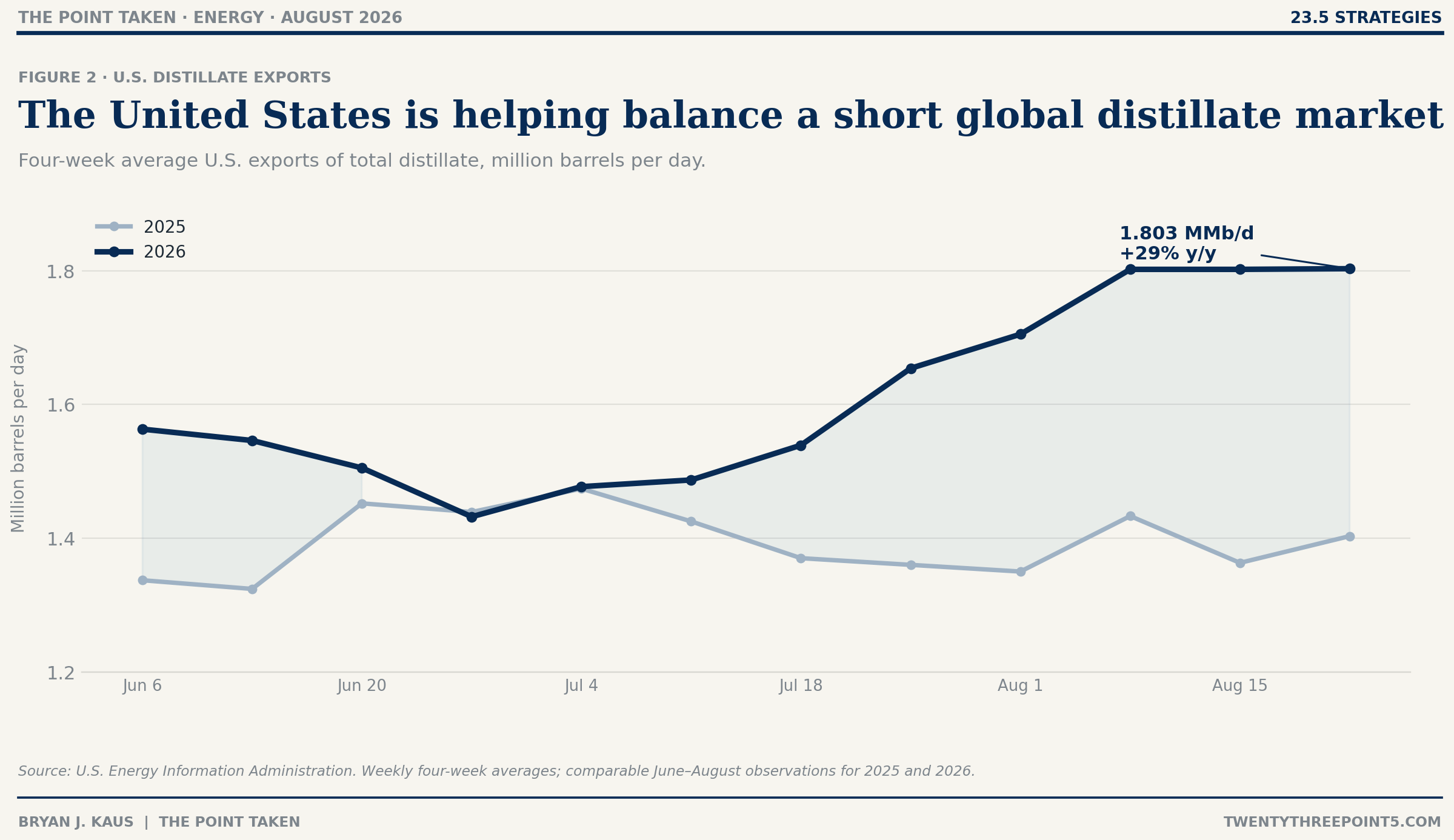
Refiners have been running near the practical limits of the U.S. system because the economics of producing the next barrel remain unusually attractive. EIA’s August outlook expects strong crack spreads to support elevated refinery runs through year-end and commercial crude inventories to remain below the bottom of their recent five-year range as high refinery demand combines with lower net imports.
The global market helps explain why. Product availability has been disrupted by the conflict in the Middle East and continued pressure on Russian refining infrastructure, leaving the United States as an increasingly important supplier into an already constrained global refined-products market. Reuters recently estimated that global refining output was running nearly two million barrels per day below demand, with U.S. refiners being asked to fill a meaningful part of that deficit.
The United States is not the only balancing mechanism, of course. Markets respond to economics. Strong diesel margins are encouraging higher refinery runs elsewhere in Asia, Chinese exports are beginning to return, and traders are moving Asian barrels into markets that had previously relied more heavily on Middle Eastern supply. That is exactly what should happen. Scarcity creates margin, margin attracts supply, trade routes reorganize, and eventually the constraint begins moving.
That broader context matters enormously for renewable diesel because renewable diesel does not somehow leave the physical fuels economy when we attach a carbon attribute to it. The carbon intensity and the regulatory value matter enormously to the producer and to many customers, but at the end of the chain the customer still receives a fungible distillate barrel.
I was reminded of the practical significance of that recently in a conversation with a fuel buyer in California who was feeling the constraint directly. He was trying to secure enough diesel to keep his operation supplied at a time when conventional availability had become increasingly difficult. We were not having an abstract conversation about decarbonization or whether his company should pay a premium in order to make progress against a sustainability target. He needed fuel. Renewable diesel was available, and in his particular situation it had become something close to the saving grace that allowed him to maintain supply.
That is a very different value proposition from the one around which much of the early renewable-diesel narrative was built.
For the person responsible for keeping trucks moving, equipment operating or an agricultural supply chain functioning, the distinction between renewable and conventional diesel becomes rather less philosophical when one barrel can actually be delivered and the other cannot.
I would not turn one customer conversation into evidence of some new national demand paradigm. It does, however, expose something that can get lost when renewable fuels are discussed almost exclusively through the language of climate policy. Renewable diesel has now reached enough scale and commercial maturity that it can provide incremental resilience to the broader distillate system. There is value in having another usable barrel available when the conventional system becomes short.
The complication is that the same scarcity demonstrating that value proposition is also helping make the economics look exceptionally attractive.
The customer needed renewable diesel partly because diesel itself was difficult to secure. That tells us something important about the product’s usefulness. It does not necessarily tell us what a normalized through-cycle margin on producing that product ought to be.
This is where the underlying diesel market has to become part of any serious discussion of current renewable-diesel economics. A stronger conventional product market raises the underlying physical value of the renewable barrel before the RIN, the tax credit, the carbon-intensity value or any other regulatory attribute is added.
The RIN market has then provided another substantial layer.
Biomass-based diesel D4 RINs reached $2.41 in early June. Because renewable diesel generates approximately 1.6 to 1.7 RINs per gallon, those credits represented more than $3.50 per gallon of potential value at the time. More interestingly, EIA noted that RIN values had risen relative to the traditional soybean-oil and heating-oil spread, suggesting that renewable diesel and biodiesel production economics had improved materially from 2025.
Then the policy discussion shifted again. EPA extended a biofuel compliance deadline, uncertainty increased around small-refinery exemptions, and biomass-based diesel RINs weakened toward $1.92.
As of the end of August, the administration was considering a considerably larger small-refinery exemption package, potentially releasing more than 1.8 billion RINs while also considering changes to future renewable-fuel obligations that could offset some of the impact. The final policy outcome remains uncertain, and it may change again after this is written.
But that uncertainty is itself useful.
High conventional fuel prices can create political pressure for refinery relief. Refinery relief can change the supply-demand balance in the compliance-credit market. That can change renewable-diesel economics even while the physical diesel market remains tight. Nothing particularly dramatic has to happen inside the renewable refinery for one meaningful layer of its margin to move.
I do not think that makes the margin artificial. Regulation is part of the market. A RIN has economic value because the law creates an obligation around it, just as a tariff, tax rate, transportation basis or environmental specification changes the economics of any number of other physical businesses.
The question is what we learn from the resulting earnings.
If cracks widen because the global refining system is short product, management did not create the shortage. If RIN prices rise because obligated demand tightens against available credits, management did not create that market either. But management absolutely has responsibility for whether the asset is available to capture the opportunity, whether feedstock is sourced intelligently, whether yields and energy consumption are competitive, whether the carbon intensity is optimized economically rather than cosmetically, whether barrels reach the market with the strongest actual netback, and whether the contracts surrounding the business preserve enough flexibility to respond when any of those variables change.
The distinction becomes visible in recent company results.
HF Sinclair’s adjusted refining gross margin rose 57% year over year to $25.95 per produced barrel sold, while adjusted EBITDA in Renewables moved from negative $2 million to positive $123 million. The company pointed to stronger RIN pricing, higher producer tax-credit benefits and increased volumes. Phillips 66 showed a similar pattern, with conventional refining benefiting from stronger market cracks while Renewable Fuels benefited from higher regulatory-credit pricing and increased production.
Neste is another useful example, particularly because its operations span both conventional and renewable fuels and because the company is relatively transparent in explaining where the changes came from. Renewable Products’ comparable sales margin increased from $361 to $1,223 per metric ton in the second quarter, while Oil Products’ total refining margin moved from $10 to $25.80 per barrel. Management described the period as an exceptional market environment, identified higher RIN prices as the primary driver of the strongest U.S. renewable-diesel margins in several years, and pointed to exceptionally wide middle-distillate cracks as a major contributor to conventional refining performance. The company was also benefiting from its own performance-improvement work while dealing with production limitations in Renewable Products.
That combination is more useful than trying to reduce the quarter to either operational excellence or market beta. Neste has spent years building genuine capability in feedstock sourcing, carbon markets, refining, logistics and renewable-fuels commercialization. That capability matters. What it cannot do, nor can any management team, is repeal the external market.
The operating skill is in capturing the opportunity when the market presents it and then deciding what should be done with the proceeds.
Follow the value backward
The same logic applies upstream.
If public policy increases the value of renewable fuel, there is no reason to assume that all of the incremental economics remain with the refinery. Feedstock suppliers see the same market developing and respond accordingly.
The United States is not the only balancing mechanism, of course. Markets respond to economics. Strong diesel margins are encouraging higher refinery runs elsewhere in Asia, Chinese exports are beginning to return, and traders are moving Asian barrels into markets that had previously relied more heavily on Middle Eastern supply. That is exactly what should happen. Scarcity creates margin, margin attracts supply, trade routes reorganize, and eventually the constraint begins moving.
That broader context matters enormously for renewable diesel because renewable diesel does not somehow leave the physical fuels economy when we attach a carbon attribute to it. The carbon intensity and the regulatory value matter enormously to the producer and to many customers, but at the end of the chain the customer still receives a fungible distillate barrel.
I was reminded of the practical significance of that recently in a conversation with a fuel buyer in California who was feeling the constraint directly. He was trying to secure enough diesel to keep his operation supplied at a time when conventional availability had become increasingly difficult. We were not having an abstract conversation about decarbonization or whether his company should pay a premium in order to make progress against a sustainability target. He needed fuel. Renewable diesel was available, and in his particular situation it had become something close to the saving grace that allowed him to maintain supply.
That is a very different value proposition from the one around which much of the early renewable-diesel narrative was built.
For the person responsible for keeping trucks moving, equipment operating or an agricultural supply chain functioning, the distinction between renewable and conventional diesel becomes rather less philosophical when one barrel can actually be delivered and the other cannot.
I would not turn one customer conversation into evidence of some new national demand paradigm. It does, however, expose something that can get lost when renewable fuels are discussed almost exclusively through the language of climate policy. Renewable diesel has now reached enough scale and commercial maturity that it can provide incremental resilience to the broader distillate system. There is value in having another usable barrel available when the conventional system becomes short.
The complication is that the same scarcity demonstrating that value proposition is also helping make the economics look exceptionally attractive.
The customer needed renewable diesel partly because diesel itself was difficult to secure. That tells us something important about the product’s usefulness. It does not necessarily tell us what a normalized through-cycle margin on producing that product ought to be.
This is where the underlying diesel market has to become part of any serious discussion of current renewable-diesel economics. A stronger conventional product market raises the underlying physical value of the renewable barrel before the RIN, the tax credit, the carbon-intensity value or any other regulatory attribute is added.
The RIN market has then provided another substantial layer.
Biomass-based diesel D4 RINs reached $2.41 in early June. Because renewable diesel generates approximately 1.6 to 1.7 RINs per gallon, those credits represented more than $3.50 per gallon of potential value at the time. More interestingly, EIA noted that RIN values had risen relative to the traditional soybean-oil and heating-oil spread, suggesting that renewable diesel and biodiesel production economics had improved materially from 2025.
Then the policy discussion shifted again. EPA extended a biofuel compliance deadline, uncertainty increased around small-refinery exemptions, and biomass-based diesel RINs weakened toward $1.92.
As of the end of August, the administration was considering a considerably larger small-refinery exemption package, potentially releasing more than 1.8 billion RINs while also considering changes to future renewable-fuel obligations that could offset some of the impact. The final policy outcome remains uncertain, and it may change again after this is written.
But that uncertainty is itself useful.
High conventional fuel prices can create political pressure for refinery relief. Refinery relief can change the supply-demand balance in the compliance-credit market. That can change renewable-diesel economics even while the physical diesel market remains tight. Nothing particularly dramatic has to happen inside the renewable refinery for one meaningful layer of its margin to move.
I do not think that makes the margin artificial. Regulation is part of the market. A RIN has economic value because the law creates an obligation around it, just as a tariff, tax rate, transportation basis or environmental specification changes the economics of any number of other physical businesses.
The question is what we learn from the resulting earnings.
If cracks widen because the global refining system is short product, management did not create the shortage. If RIN prices rise because obligated demand tightens against available credits, management did not create that market either. But management absolutely has responsibility for whether the asset is available to capture the opportunity, whether feedstock is sourced intelligently, whether yields and energy consumption are competitive, whether the carbon intensity is optimized economically rather than cosmetically, whether barrels reach the market with the strongest actual netback, and whether the contracts surrounding the business preserve enough flexibility to respond when any of those variables change.
The distinction becomes visible in recent company results.
HF Sinclair’s adjusted refining gross margin rose 57% year over year to $25.95 per produced barrel sold, while adjusted EBITDA in Renewables moved from negative $2 million to positive $123 million. The company pointed to stronger RIN pricing, higher producer tax-credit benefits and increased volumes. Phillips 66 showed a similar pattern, with conventional refining benefiting from stronger market cracks while Renewable Fuels benefited from higher regulatory-credit pricing and increased production.
Neste is another useful example, particularly because its operations span both conventional and renewable fuels and because the company is relatively transparent in explaining where the changes came from. Renewable Products’ comparable sales margin increased from $361 to $1,223 per metric ton in the second quarter, while Oil Products’ total refining margin moved from $10 to $25.80 per barrel. Management described the period as an exceptional market environment, identified higher RIN prices as the primary driver of the strongest U.S. renewable-diesel margins in several years, and pointed to exceptionally wide middle-distillate cracks as a major contributor to conventional refining performance. The company was also benefiting from its own performance-improvement work while dealing with production limitations in Renewable Products.
That combination is more useful than trying to reduce the quarter to either operational excellence or market beta. Neste has spent years building genuine capability in feedstock sourcing, carbon markets, refining, logistics and renewable-fuels commercialization. That capability matters. What it cannot do, nor can any management team, is repeal the external market.
The operating skill is in capturing the opportunity when the market presents it and then deciding what should be done with the proceeds.
Follow the value backward
The same logic applies upstream.
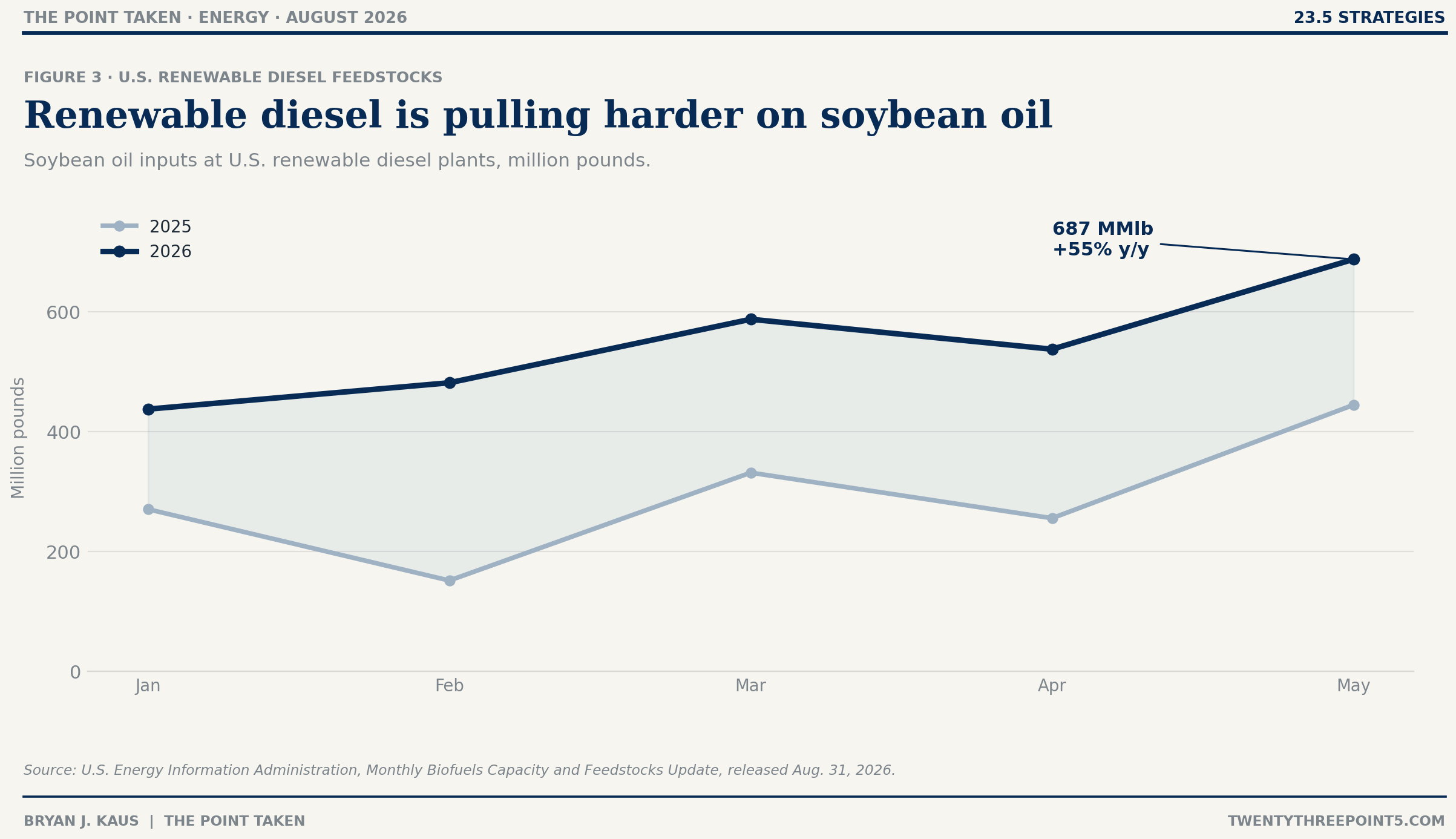
If public policy increases the value of renewable fuel, there is no reason to assume that all of the incremental economics remain with the refinery. Feedstock suppliers see the same market developing and respond accordingly.
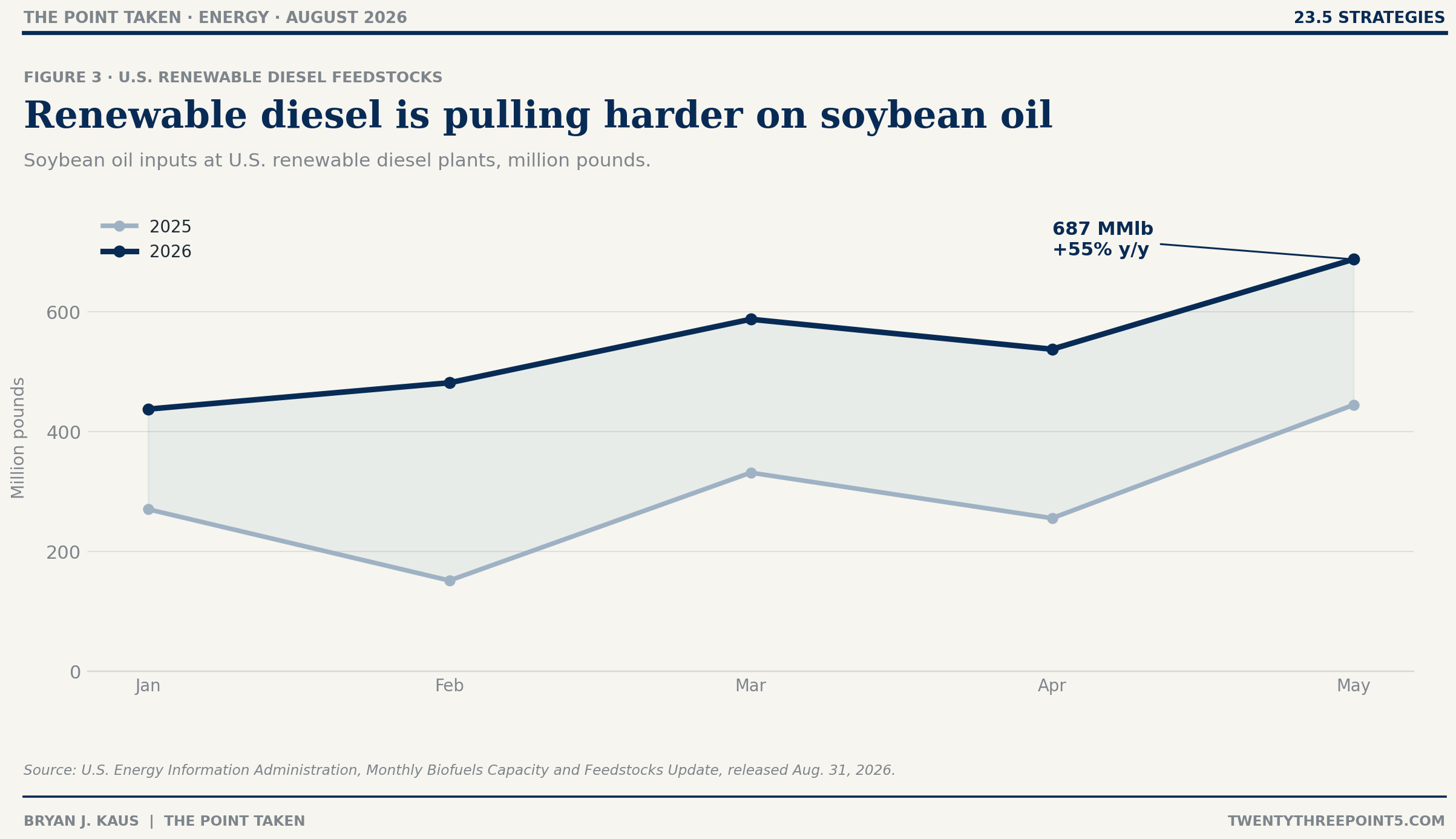
Used cooking oil, yellow grease, tallow and soybean oil now sit inside a transportation-fuel value chain in which carbon intensity, country of origin, regulatory eligibility and tax treatment can materially change what the feedstock is worth. These are not merely waste or agricultural commodities being purchased by a refinery. In the right circumstances, they carry an embedded regulatory option.
The revised 45Z framework makes that more consequential. For clean transportation fuel produced after December 31, 2025, qualifying fuel generally must be derived exclusively from feedstocks produced or grown in the United States, Mexico or Canada. The special higher applicable amount that had previously been available to SAF has also been eliminated for post-2025 production.
That inevitably changes the sourcing map. As renewable diesel, biodiesel and SAF compete for qualifying lower-carbon feedstocks, some of the additional value created downstream can be bid upstream into the cost of securing the feedstock in the first place.
This is why I am wary of evaluating these businesses primarily around a headline refinery margin. A plant can run exceptionally well and still surrender a large share of incremental regulatory economics in the feedstock procurement process (I’ve seen miscalculation of this brutalize margins). A commercial team can obtain a very attractive destination price that becomes considerably less impressive once freight, inventory exposure and working capital are included. At the other extreme, a producer can become so determined to extract every possible downstream dollar that it takes on logistics and destination risk for relatively little incremental enterprise value.
There will be times when clearing the renewable refinery closer to the gate is the better answer. There will be other times when the carbon value, destination premium, customer position or logistics advantage makes carrying that same barrel farther downstream overwhelmingly more attractive.
The point is not that one commercial model is always better. Rather, the point is that the economics belong to the enterprise.
One of the concepts driven into me when I was younger in this business was the idea of the general interest. It was a simple expression for something companies often find surprisingly difficult to do in practice. The job was not necessarily to maximize the apparent economics of your desk, terminal, refinery or business unit. The job was to produce the best economic outcome for the company, wherever in the chain that margin was ultimately captured.
Sometimes that meant one part of the organization apparently giving something up because the company could make more money somewhere else.
It sounds obvious until the arithmetic collides with the organizational chart, internal politics, or lack of clarity in what is actually happening inside of the business - this is why organizations need to be transparent about how the enterprise is performing. Without that, and yes, this is something I’ve seen too, there is no way for the organization to truly optimize - at least not efficiently.
Feedstock procurement is measured on what it pays. The refinery is measured on utilization, yield and cost. Logistics wants to minimize freight. Sales wants the best customer price. Trading sees the arbitrage. Sustainability sees carbon intensity. Finance is managing cash and working capital.
Every one of those functions can make a rational decision and the company can still make the wrong one.
That is not merely a commercial problem. It is an operating-model problem, and I think it has been underappreciated in parts of renewable fuels precisely because so much attention has understandably been spent building the physical and regulatory capabilities required to create the industry in the first place.
As the sector matures, the standard has to move.
The company needs the analytical capability and the organizational permission to look across the whole chain and ask what the feedstock available today should become, where the resulting product should go, which attributes should be monetized, what risks the company should continue to own, and where the best risk-adjusted enterprise return actually sits.
That question becomes particularly interesting when the choice is not merely where to sell the molecule, but which molecule to make.
SAF and renewable diesel share many feedstocks and, in flexible HEFA facilities, much of the same processing infrastructure. But they are not economically interchangeable products with different marketing labels. Their yields, processing requirements, customer structures, compliance mechanisms and demand profiles differ.
Europe now provides a more structural component of SAF demand through ReFuelEU Aviation, which requires SAF to represent at least 2% of aviation fuel supplied at EU airports and increases that requirement to 6% in 2030, with considerably higher obligations beyond that. That is economically different from depending primarily on a voluntary corporation’s continued willingness to pay a green premium.
At the same time, the U.S. incentive structure has changed with the removal of the special higher post-2025 45Z applicable amount for SAF.
For a flexible operator, the right answer therefore cannot be reduced to comparing the selling price of SAF with the selling price of renewable diesel. A higher SAF premium does not necessarily create a higher enterprise return if additional processing, yield loss, hydrogen requirements or foregone renewable-diesel production consume the advantage.
The real comparison is the net economic contribution of each pathway after the feedstock, yield, hydrogen, energy, carbon value, regulatory credits, contractual premiums, freight, working capital and opportunity cost of the alternative are considered together.
That answer will move with the market, which means the operating model needs to be capable of moving with it.
The conventional system offers the same lesson
Conventional refining provides a useful comparison because the industry is dealing with another version of the same problem today.
When every additional barrel is exceptionally valuable, there is an obvious incentive to run.
For the week ending August 21, U.S. refinery utilization reached 97.4%, with crude inputs of approximately 17.4 million barrels per day, after an unusually sustained period above 95%.
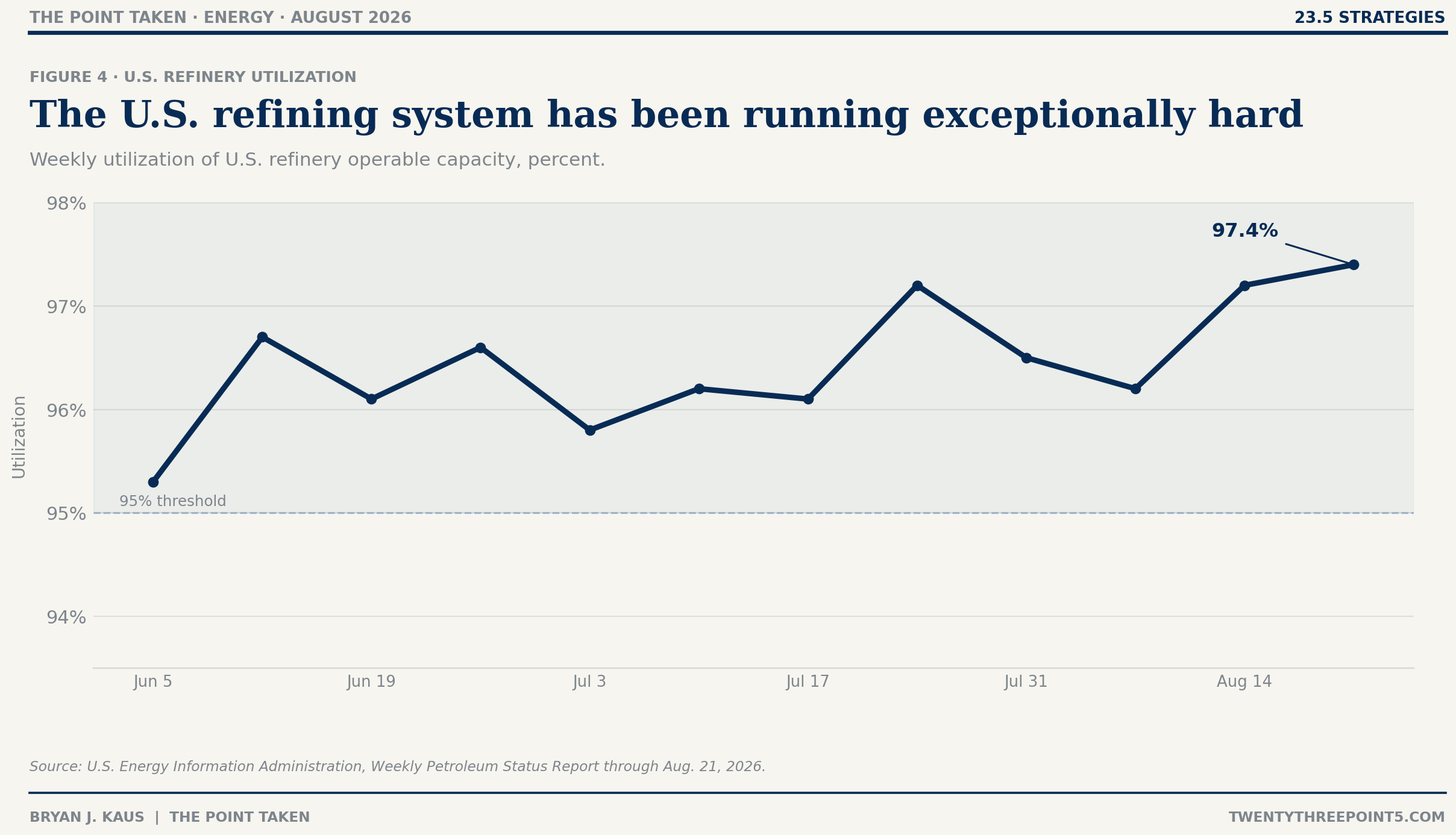
Media and analyst coverage, as well as commentary from earnings calls have captured that some refiners shifted maintenance in order to capture exceptional product margins, while noting that past periods of prolonged high utilization have sometimes been followed by greater unplanned outages as maintenance needs accumulated.
I would be careful about what conclusion we draw from that. Changing the timing of maintenance is not inherently irresponsible. Turnaround schedules are not locked calendars, and nobody who has actually operated industrial equipment should pretend that every piece of work has identical urgency. Unit condition matters. Inspection results matter. The work list matters. Good operators are constantly determining what needs to happen now, what can safely move, and what continued production is worth.
But the equipment does not know the crack spread.
Maintenance that can safely be deferred is still maintenance. Catalyst ages. Equipment wears. Inspection intervals eventually arrive. The economics of operating today do not make the physical requirement disappear.
That does not mean refiners are compromising safety to make money, and I would not make that accusation without evidence. It means something more useful from a management perspective: reliability becomes increasingly valuable as scarcity increases.
When product markets are comfortably supplied, the system can absorb an outage through inventory, imports, unused capacity elsewhere or adjustments in trade. When the global market is already short and the U.S. system is running close to its practical limit, the replacement barrel becomes substantially harder to find.
The same strong market therefore increases the value of another week of production and the economic consequence of unexpectedly losing the unit.
That is where the optimization becomes difficult.
Commercial sees the crack and knows what another week is worth. Operations understands the physical condition of the equipment. Maintenance understands the work that is accumulating. Finance sees the extraordinary incremental cash generation. Management’s job is to integrate those physical realities rather than allow whichever function has the loudest number that week to determine the answer.
There are circumstances where continuing to run is absolutely rational. The incremental cash generated during an unusually strong market can more than pay for a larger turnaround later. But that conclusion needs to come from a disciplined understanding of the asset and the economics together.
The U.S. Energy Information Administration expects some of that balance to shift this fall. After crude inputs of roughly 17 million barrels per day through August, the agency forecasts refinery inputs dropping below 16 million barrels per day on average in October as normal seasonal maintenance reduces utilization and product output.
That matters because product markets do not necessarily normalize simply because one source of disruption eases. Inventories have to rebuild. Trade patterns have moved. Russian product availability remains uncertain. U.S. refineries then enter maintenance season after an unusually demanding summer run.
The market can solve one constraint and discover the next one already waiting behind it.
The Point Taken
I do not come away from any of this bearish on renewable fuels.
The structural improvements are real. Germany has tightened its transport-fuels compliance framework and the resulting HVO demand signal is substantial. Europe is creating mandated SAF demand rather than relying entirely on voluntary customer ambition. U.S. renewable-fuel requirements continue to provide a regulatory demand base. And renewable diesel has demonstrated another source of value that deserves more attention: when the conventional distillate system becomes short, another fungible barrel can matter simply because somebody needs the fuel.
But the current economics are the product of several things at once, and those things will not necessarily move together forever.
Some of today’s margin comes from structural regulatory demand. Some comes from conventional-product scarcity. Some comes from RINs and tax credits. Some reflects an advantaged feedstock position or a logistics network that puts the company in the right place. And some is the result of management actually doing the work better: running reliably, sourcing intelligently, optimizing the product slate, contracting well and allocating capital with discipline.
Those are all legitimate economics. They simply have different durability and, importantly, do not always accrue to the same participant.
A German compliance obligation is not the same thing as low water on the Rhine. A European SAF mandate is not the same thing as a customer’s voluntary willingness to pay a premium. An advantaged feedstock position is not the same thing as an unusually high RIN price. A refinery that has earned superior reliability across a cycle is not the same thing as an asset that happened to be available during an exceptional quarter.
Eventually the returns on capital make those differences visible.
That is why I think the useful question for a board today is larger than whether renewable diesel or SAF happens to be attractive at current margins. The question is whether management really understands why the margin exists, where in the chain the economics are being created and captured, which parts of that advantage the enterprise can reasonably defend, and what the company is doing with the cash that the market is currently giving it.
Treating peak economics as permanent is one way to squander a cycle. Permanent costs get built around temporary margins. Feedstock commitments are signed because today’s credits make the arithmetic work. Projects are sanctioned using assumptions that happen to reflect an unusually favorable moment. Operating problems that would be obvious in a weaker environment disappear beneath a strong benchmark.
The other choice is to use the same period to strengthen the balance sheet, invest in reliability, improve feedstock optionality, remove structural cost, sharpen commercial and logistics capability, manage working capital and preserve the flexibility to move among products and markets as the economics change.
Neste’s leverage fell from 34.3% at the end of 2025 to 29.9% at the end of June. That does not prove anything sweeping about the company or the industry, but it does illustrate what an exceptional market can make possible when strong cash generation is allowed to build resilience.
Renewable fuels are back in the money. That part is not especially difficult to see.
The harder question is what changed, which parts of the improvement actually belong to the business, and whether the companies benefiting from it are using the opportunity to become stronger before the market changes the question again.
The best time to figure that out is while the margins are still good.
© 2026 23.5 Strategies; The Point Taken™
The author previously worked in the renewable fuels industry, including at Neste and Phillips 66. This article is based entirely on personal perspective, publicly available information and industry experience.