



By Bryan Kaus
It is a bad plan that admits of no modification.
- Publilius Syrus
I have already argued that AI has become a capital-governance test. This is the narrower question that follows it: what happens after capital responds to a real shortage?
In looking for an example for this piece, I found myself drawing on the history of the renewable fuels buildout as useful lesson.
AI infrastructure can be necessary, strategically important and part of an extraordinary long-term growth market, and still produce poor investments at the margin. A growing market and a good investment are not the same thing.
What matters is not simply whether demand exists. It is whether the project can still earn an adequate return when financing changes, capacity arrives, pricing normalizes or some other assumption underneath the original model moves.
That is the lesson I would rather learn before the stress test than after it.
The stress test I know
I touched on this challenge in my recent piece on ConocoPhillips, but for me, the most useful recent case study is renewable fuels, particularly renewable diesel and sustainable aviation fuel. I spent a lot of time thinking about those markets from inside the industry, including in my strategy work at Neste.
The long-term demand case was real. So were the policy signals. Capital was available, incentives were powerful and companies across the industry responded rationally to what the market appeared to be telling them. They cleared FID and they built.
One of the risks I kept coming back to was not that renewable fuels would somehow cease to matter. It was that capacity could grow faster than the economics supporting it.
I was not predicting that renewable fuels would fail. I was worried that some of the business models being built around them would when put under stress. Markets are cyclical and it can be difficult to read the cycle, even in mature sectors, that is doubly hard for those that are a bit more nascent.
That distinction eventually became visible. Renewable diesel capacity expanded, while credit economics, feedstock realities and conventional refining margins moved. By early 2025, U.S. renewable diesel production was down even as installed capacity had increased, and major producers reported operating losses. EIA’s data captured the disconnect between capacity and profitable utilization.
Facilities were idled. Projects were delayed or cancelled. Some companies ultimately went under. The demand itself had not disappeared; the economics underneath some of the capacity had.
That was the first lesson. The second was more useful: waiting for competitors to die is not a strategy.
The stress test has to change the business
A downturn can clear market excess. Weak balance sheets can fail. Supply and demand can rebalance. None of that, by itself, makes the survivor a better company.
The stress test has to change the operating model. Reliability has to improve. Structural cost has to come down. Working capital has to be governed more carefully. Investment has to become more selective. The balance sheet has to be capable of absorbing another disappointment rather than merely celebrating survival of the last one.
That is part of what makes the current renewable-fuels recovery interesting. The market itself has improved materially, and the exceptional 2026 margin environment is a major part of the rebound. But the operating base has changed too. Neste, for example, reported a cumulative €594 million run-rate improvement versus its 2024 baseline by the end of the second quarter, while leverage fell to 29.9%. Those improvements do not replace the market recovery; they change how effectively the company can capture it.
That is the distinction I care about: a stronger market can rescue earnings. A stronger business makes the recovery more durable.
I will write more about renewable diesel and SAF in the coming weeks because that cycle deserves its own treatment. For now, the lesson is enough. Genuine demand does not rescue an operating model or a capital structure that only works under favorable conditions.
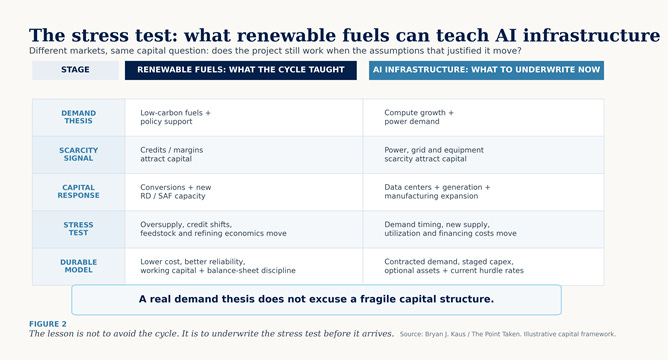
What this changes for AI infrastructure
Today’s AI buildout is not an exact replay of renewable fuels or the zero-rate environment. The hyperscalers have enormous cash flows and balance sheets. Much of the capital is abundant because the strategic urgency is real, not because financing is free.
But abundant capital can create the same behavioral problem. Everybody sees the shortage. Everybody sees the attractive return. Everybody reaches for capacity at roughly the same time.
The mechanism is simple. Scarcity creates pricing power. Pricing power attracts capital. Capital creates supply. The new supply changes the scarcity that justified the investment in the first place.
The original demand thesis does not have to be wrong for the marginal project to become a poor investment when market conditions change.
That is why I would separate companies monetizing existing scarcity from companies underwriting large amounts of future scarcity.
If I already own the site, the interconnection, the gas position, the manufacturing line, the skilled workforce or the power asset, stronger demand may improve utilization and return on capital already deployed. If I have to commit billions today because I assume the current shortage still exists when a project enters service five years from now, I am making a different bet.
Both can be viable truths. The second, however, carries more duration, execution and forecasting risk.
Own optionality before you build capacity
This is the principle I keep returning to across refining, pipelines, power and manufacturing: own optionality before you build capacity.
That does not mean never building. It means preserving the right to learn. Expand incrementally where you can. Stage commitments. Secure customers before capacity where the structure allows it. Reuse assets that can serve more than one future. Match long-lived investments with financing that does not force a decision at the worst possible time (this is key).
The best project is not always the one with the highest modeled return. Sometimes it is the one that still has options to success when the model is wrong.
Capital has a price, and the hurdle should move with it
A recent Dallas Fed working paper I caught in my inbox last week, adds a useful macro reminder. The researchers find that government debt financed from foreign borrowing has a larger estimated effect on interest rates than debt financed from domestic savings, and that net international creditor countries tend to face a smaller rate effect than net debtors.
I would not turn that into a rate forecast. I would take the simpler lesson: the marginal provider of capital matters, capital has alternatives and the return required to attract the next dollar moves.
Hurdle rates should move too.
A project that created value in one financing environment does not automatically create value in another. Clearing the weighted average cost of capital is not a permission slip to deploy money. A long-lived asset has to pay for execution risk, forecast error, illiquidity and the opportunity cost of committing capital that may not be recoverable for decades.
Concrete and steel is less forgiving than code. An asset built around the wrong assumptions can sit there being wrong for a very long time.
So do not build a plan that requires capital to become cheap again. If it does, great. Let that be upside, not the assumption holding the economics together.
Capital stewardship is the ability to remain adaptive
The hard part of this is behavioral. Executives want to win. Boards want growth. Investors want returns. Then a competitor announces something enormous and restraint can begin to feel like falling behind.
That is how favorable conditions get promoted into permanent assumptions (and then become a liability).
Capital stewardship is not the avoidance of risk by any means. It is taking risk without building a structure that requires everything to go perfectly to plan. Liquidity, operating flexibility and balance-sheet capacity are not signs that management lacks conviction. They preserve the ability to act when the facts change.
The goal is not merely to survive the stress test. It is to have enough flexibility to learn from it, enough discipline to change the business and enough financial strength to participate when the opportunity improves again.
That was the deeper lesson in renewable fuels. It is the one I would carry into AI infrastructure.
The Point Taken
The useful question is not whether AI demand will grow. I think it will. It is whether a particular investment still creates value if demand arrives later, capacity arrives faster, financing stays expensive or execution is imperfect.
I would watch who already owns scarce and useful infrastructure, who can add capacity incrementally against visible demand, who has customers willing to support the economics and who preserves enough optionality to change course when one of the assumptions moves.
That is the distinction between participating in a boom and stewarding capital through a cycle.
A growing market is not necessarily a good investment. A downturn is not necessarily a failed thesis. And a recovery is not enough if the business learned nothing from the stress.
Cheap capital is not a business model.
© 2026 23.5 Strategies; The Point Taken™ Bryan J. Kaus